Automotive Blog Automotive Blog brings you the latest news, car reviews and information on the automotive industry.
Head to any decent car gathering in 2026, and one detail immediately jumps out that would’ve seemed bizarre half a decade back: lit-up brand emblems. This isn’t fancy main beams, daytime running light bars, or neon floor glow kits—we’re talking the official brand logos fitted to front grilles and trunk lids, softly backlit in crisp white light, looking just as polished and seamless as factory stock hardware. Once only reserved for fully customized show vehicles, glowing badges have fully seeped into everyday car hobby culture, and search data backs up this huge rise. Online searches for light-up car emblems keep climbing each year, and dedicated aftermarket shops have steadily broadened their product ranges to keep up with demand.
What’s caused this massive surge in popularity? More importantly, what should shoppers keep top of mind before jumping on this mod trend? We’ll cover everything sorted by car brand, core internal tech, and the key differences between a quality upgrade you’ll love long-term, and a cheap kit that’ll make you swap back to your stock factory badge in half a year.
The Technology Behind a Good Illuminated Emblem
How lit-up emblems work is pretty simple: these aftermarket replacement logos come with an LED panel mounted underneath their surface. Hook them up to your parking light wiring, and they light up every time you flip on your vehicle’s exterior lights. Where products truly diverge is their construction quality. Cheap entry-level kits mount standalone LEDs spaced apart behind the emblem. This leads to inconsistent lighting, with harsh bright dots scattered amid dim, shadowed sections of the badge. Premium variants add a light diffusion film between the LEDs and outer logo face; this layer evens out brightness for a uniform, seamless glow over the entire emblem.
Fit quality is the other huge difference maker. Badges custom-machined to match a single model and year slide straight into the factory mount, sit flush against the bumper or trunk panel, and have zero noticeable gaps. Universal emblems that rely on adapter rings can never pull off that tight, OEM-style fit. Retailers like LED Car Emblem focus entirely on vehicle-specific molds, earning them steady recommendations from car enthusiast forums over generic universal parts. Properly made illuminated badges install in under 30 minutes, no permanent drilling or trimming needed. They connect to your factory parking light harness without cutting or splicing wires. This mix of clean OEM-like looks and damage-free fitting is the main reason this mod has blown up with casual car owners.
VW Light Up Emblems: Why the Roundel Rules
Volkswagen moves more lit brand emblems than any other car brand, and it’s easy to see why. Models including the Golf, Polo, Tiguan and T-Roc are everywhere across UK roads. On top of that, the brand’s circular logo is far simpler to manufacture as an illuminated piece. Its round shape and basic two-tone layout deliver balanced, uniform lighting, without the complicated light spreading needed for elaborate, multi-part crests.
The VW light up emblem market got another boost after the Mk8 Golf and all-electric ID. lineups launched—these cars draw younger owners who regularly invest in cosmetic add-ons. You can pick up backlit logos for the front grille, rear trunk and steering wheel hub alike. Steering wheel emblems stand out as a fan favourite for drivers who like subtle interior tweaks instead of obvious exterior mods. Fitment by vehicle generation is non-negotiable when shopping. Mk8 Golf badges have unique sizing compared to Mk7 models, while the ID electric range uses a completely separate mounting setup. Grab a logo made for the wrong generation, and it won’t sit level with the body panels, ruining the whole finished look.
VW drivers have a long-running hobby culture focused on small, precise custom parts, making them very well-informed shoppers for this upgrade. Longstanding forum talks and social media build logs have set solid standards for quality, and first-time buyers can lean on this shared experience to pick reliable sellers.
Audi Light Up Emblems: The Four-Ring Engineering Challenge
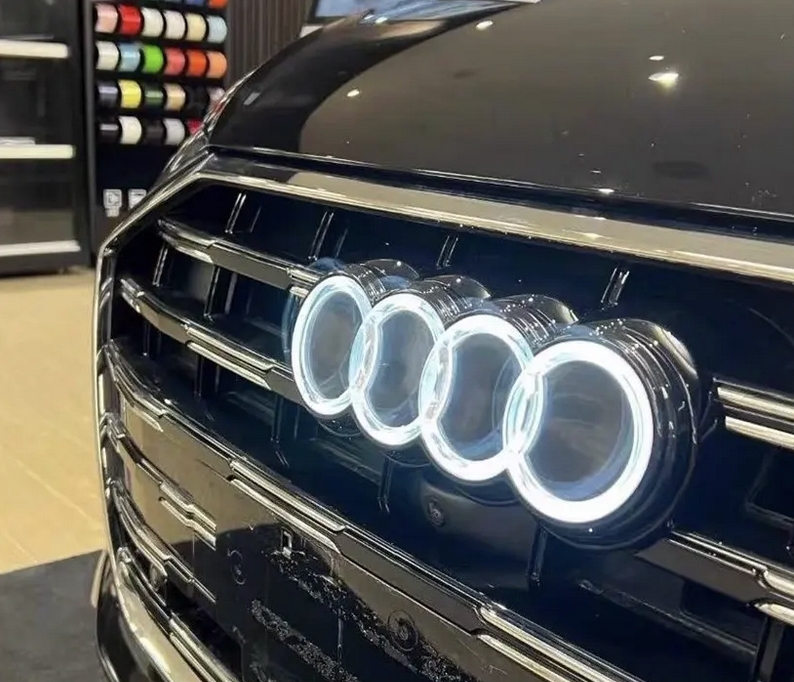
Audi’s four-ring logo is widely seen as the hardest mainstream badge to produce as an illuminated aftermarket piece. Single round emblems only need steady light spread inside one solid outline, but the four interlocked rings demand equal brightness across four distinct shapes. The gaps between each ring must stay sharp and defined, with zero stray light seeping over the dividing lines. Any cheap kit that gets this wrong—uneven brightness between rings or blurred light spillage—ends up looking far tackier than the stock unlit logo, and hitting that precise light control calls for tight, precise engineering.
The best versions of the Audi light up emblem skip scattered individual LEDs and run a continuous LED strip tracing the edge of every ring instead. This method delivers clean, uniform glow for each ring, mimicking the polished finish of original factory lighting rather than a cheap aftermarket add-on. Colour temperature is another key detail Audi enthusiasts zero in on. OEM Audi daytime running lights and headlights sit around 6000K cool white. If you fit a 4000K warm-white illuminated badge, the tone clash with the car’s factory lights will be immediately obvious, and owners online frequently call out this mismatch. Trusted sellers always list the exact Kelvin rating in product descriptions; if a listing leaves out this spec entirely, it’s a clear sign to shop another brand.
Cadillac Light Up Emblems: The Most Complex Badge, Done Properly
The Cadillac shield crest stands as the most visually intricate badge covered in this guide, and it also shows the starkest quality divide between well-crafted and shoddy illuminated alternatives. Unlike Volkswagen’s circular logo or Audi’s interlocking rings, the Cadillac crest boasts a partitioned layout with separate colour segments, sharp angular lines and traditional heraldic features that form the core of the brand’s visual signature. Low-cost illuminated models light the whole shield as one unified backlit sheet, casting a bland flat white glow that erases every delicate detail. The finished result barely resembles the factory badge it was meant to replace.
A properly engineered Cadillac light up emblem fixes this flaw through segmented lighting control; every partition of the shield lights separately, retaining the original crest’s colour separation and geometric definition once night falls. On an Escalade’s prominent large front grille badge, the visual gap between segmented premium kits and single flat-panel units is instantly noticeable. Cadillac’s on-road owner group may be smaller, yet its members are highly passionate about refining their driving experience, which creates strong demand for aftermarket parts matching the vehicle’s premium factory standard. Only retailers that tailor their designs specifically to the unique structure of the Cadillac shield are worth purchasing from.
Where the Market Is Heading
The hype around backlit emblems continues to grow with no signs of tapering off. LED components have dropped in price while production accuracy advances steadily, lifting the minimum quality standard industry-wide—today’s mid-tier badge kits deliver effects that once only expensive premium versions could pull off three years back. Top-tier manufacturers counter this by refining OEM-level fitting accuracy and custom-tuned colour rendering for distinct vehicle models, pushing the overall quality benchmark for all aftermarket products higher.
Shoppers now enjoy a much more user-friendly buying environment. Specialty stores stocking car-specific product lines, validated fitment records and fully disclosed technical parameters are much simpler to locate these days. Additionally, the massive pool of experience shared among automotive enthusiasts, saved on forums, social platforms and car build posts, allows buyers to pick out trustworthy suppliers well before placing an order. This exterior modification, which once demanded exclusive insider know-how to install properly, is now available to any car owner prepared to spend twenty minutes reading up beforehand.
The glowing badge in the car park is not going anywhere. If anything, it is becoming the new normal.